FDA OCE response on dose individualization

Here is the text of FDA’s April 20, 2020 response to a query submitted on my behalf Jan 22 by the office of Congresswoman Rep. Pramila Jayapal. (Advance to page 2 of this post to see the text of my Jan 20 letter to Rep. Jayapal.)

The following is a response to the request that Rep. Pramila Jayapal received from Dr. David Carl Norris regarding dose individualization in clinical trials, specifically in the area of oncology trials.

The Food and Drug Administration (FDA) Oncology Center of Excellence (OCE), authorized by the 21st Century Cures Act, was established as FDA’s first Inter-Center Institute in 2017, to facilitate the development and clinical review of oncology products by uniting scientific experts across FDA’s product Centers to conduct a coordinated review of drugs, biologics, and devices. The OCE has successfully collaborated with other FDA Centers to develop over a dozen Guidances for Industry regarding various topics on the clinical aspects of oncology drug development and is known for regulatory flexibility. The OCE has encouraged developers to consider novel trial designs that better serve the needs of patients with cancer, including various types of master protocols, including those with common control arms, “umbrella” trials, and “basket” trials, as well as novel clinical trial endpoints, such as metastasis-free survival in non-metastatic castration-resistant prostate cancer and minimal residual disease in hematologic malignancies.

As Dr. Norris noted in his letter, in this same spirit, the Center for Drug Evaluation and Research’s Office of Oncology and Hematology Products and the OCE held three workshops in 2015-17 in conjunction with the American Association for Cancer Research (AACR) to identify best practices for optimizing dosing across the entire life cycle of product development. Although individualized patient dosing was not discussed in detail during these meetings, the OCE is supportive of drug development programs evaluating individualized patient dosing based on clinical signs, laboratory findings, or therapeutic drug monitoring measured by an accurate and reliable test method. The results of population pharmacokinetic analyses, exposure-response and exposure-toxicity modeling, information on drug interactions and food-effects (for orally administered products) result in individualization of starting doses for all oncology drugs. Subsequent individualization of dosing is typically based on tolerability and toxicity. However, in contrast to the diseases and conditions mentioned in Dr. Norris’ letter (e.g., hypertension, hypothyroidism, diabetes), currently there is no rapidly measurable clinical or laboratory pharmacodynamic measure (e.g., blood pressure, TSH, glucose) that would allow individualization of dosing in patients with various cancers based on pharmacodynamic effects on tumors that have been scientifically validated to predict clinical outcomes. Please note that FDA has encouraged the development of pharmacodynamic biomarkers that may assist in drug development, including through exploratory INDs and through participation in FDA’s Biomarker Qualification Process.

Finally, we caution that every investigational drug product development program is evaluated on its own merits. As a result, FDA cannot make a blanket statement that we would either accept or reject any particular dose optimization method or trial design. Such alternative dosing strategies can only be evaluated in the context of the cancer type and stage, the patient population, the information available regarding the investigational drug, the information available regarding the biomarker to be used to guide an individualized dosage regimen, and the details of the trial design.

Thank you for your interest in this topic. Below, we provide links to potential additional resources for your constituent:

Oncology Center of Excellence – (https://www.fda.gov/about-fda/fda-organization/oncology-center-excellence) This is FDA’s main website for OCE and includes contact information by which constituents may reach FDA staff.

Dose Finding of Small-Molecule Oncology Drugs: Optimization throughout the Development Life Cycle – (https://www.ncbi.nlm.nih.gov/pubmed/27250931).

Comment on Wages et al., Coherence principles in interval-based dose finding

UPDATE: (Mar 30) Yesterday, PST published my letter online. Wages, Iasonos, O’Quigley & Conaway thus far appear to have offered no reply despite ample time to do so.

UPDATE: (Jan 10) Editor has judged revised letter suitable for publication in Pharmaceutical Statistics, and has sent it out to invite a response.

UPDATE: (Dec 19) Per Editor’s request, I’ve revised to halve the word-count. Remarkably, this has only strengthened and focused the argument.

This Comment is currently in review at Pharmaceutical Statistics, the official journal of PSI. The original piece was published online ahead of print, on Nov 6. Consistent with this journal’s admirable preprint policy, I post the submitted document below. You are welcome to download it, and of course to comment.

On the MTD heuristic and the TLA shell-game

*TLA = Three-Letter Acronym

Special thanks to Sandra Spivey for spurring me to expand upon this important topic at long last!

Sandra’s multifaceted question demands a clear exposition of what I have termed the MTD heuristic. As Sandra indicates, the MTD concept has acquired something of a murky and esoteric character. I’ll try to pierce the fog in 3 steps: heuristics, history and histrionics.

Heuristics

The word heuristic is cognate to Archimedes’ “Eureka!” (“I have found it!”) which he famously shouted as he ran naked through the streets of Syracuse, upon discovering the principle of buoyancy in his bath. My own usage of the word follows George Pólya’s treatment in his classic book How to Solve It, where he describes heuristics as general patterns of behavior you can adopt consciously when solving problems. In the book, Pólya focuses on math problems, but the notion applies in all kinds of problem-solving activity.

For example, when Sir William Osler (the ‘Father of Modern Medicine’) said “Listen to your patient; he is telling you the diagnosis”, he was articulating a diagnostic heuristic that focuses the physician’s attention on the words and concerns as expressed by the patient.

In the question of dosing chemotherapy drugs, the maximum-tolerated-dose heuristic embodies the view that chemotherapy is a crude instrument—a cytotoxic agent that hurts all the cells of the body, but hurts cancer cells most of all. If a cancer is deadly, and the intent of treatment is to cure—i.e, to eradicate the cancer—then it seems reasonable to give this poison in a series of massive, barely-tolerable doses seprarated by brief intervals when the patient (but not the cancer, we hope) can recover. These are of course the familiar ‘cycles’ of chemo.

It should be said that general aspects of this heuristic apply outside of cancer treatment. Hippocrates himself said, “For extreme diseases, extreme methods of cure, as to restriction, are most suitable.” I’m not quite sure what he meant by “as to restriction,” but certainly this calls to mind the dreadful story of how—before the discovery of insulin—children with diabetes were treated by starvation.

The MTD heuristic also generalizes even beyond medicine. Chemo cycles are a medical example of a widely applicable engineering principle called a bang-bang control. Under some models of cancer growth and treatment, one can prove mathematically that such chemo regimens are optimal.

But of course, when you do math, the results you get out exactly match the assumptions you put in. When you change your assumptions about cancer growth and treatment, the math may show that other heuristics work best. One much-discussed alternative is metronomic chemotherapy, almost the exact opposite of traditional chemo cycles driven by the MTD heuristic:

Metronomic chemotherapy is based on the chronic administration of chemotherapeutic agents at relatively low, minimally toxic doses, and with no prolonged drug-free breaks

Pasquier E, Kavallaris M, André N. Metronomic chemotherapy: new rationale for new directions. Nat Rev Clin Oncol. 2010 Aug;7(8):455–65. PMID 20531380

I mention metronomic chemo here only because helps me to put the MTD heuristic into context as merely one of several heuristics that may apply in cancer treatment. Most of my further discussion here will assume that the basic assumptions upholding the MTD heuristic are correct. Chief among these is that treatment is being pursued with curative intent.

History

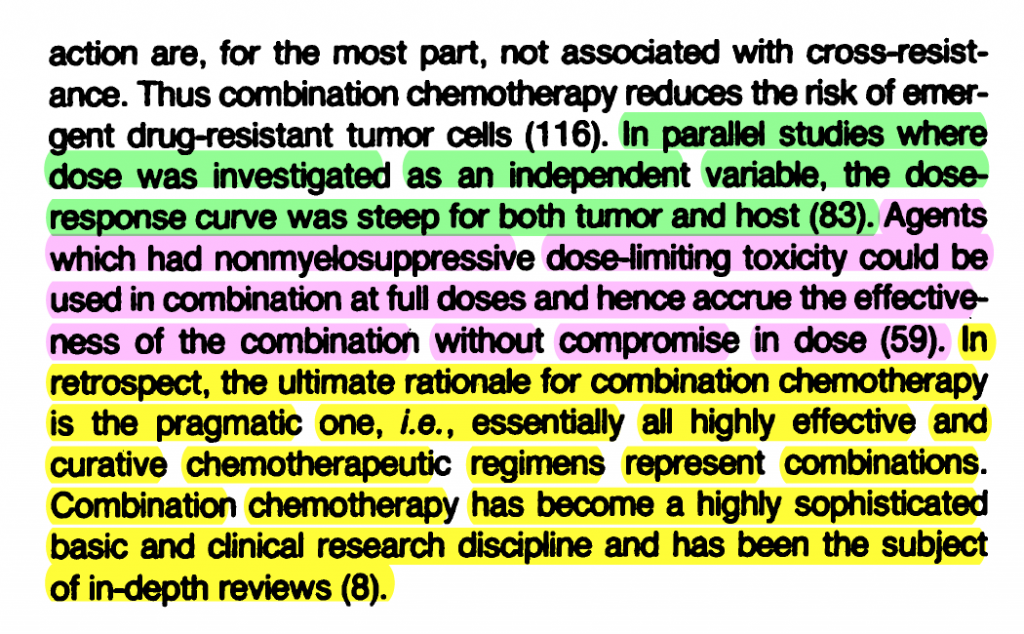
Emil Frei’s 1985 paper “Curative Cancer Chemotherapy” explains the rationale for high-dose combination chemotherapy regimens, as emerging from the achievement of “curative treatment for some 12 categories of cancer.” In this review, Frei appeals repeatedly to “steep” dose-response curves, often juxtaposing toxicity with efficacy by mentioning patient and tumor responses in the same breath:

1. 
Frei E. Curative cancer chemotherapy. Cancer Res. 1985 Dec;45(12 Pt 1):6523–37.

Frei’s paper is open-access, and it seems to me eminently readable for a cancer patient advocate. I’ve also posted my own PDF copy in case my highlights and notes would be of any use in focusing on questions related to dose-response.

Histrionics

The Winter 2018–19 issue of CancerWorld newsletter featured a cover story ostensibly challenging the MTD heuristic via a “minimum effective dose” (MED) concept:

As noted in my hot-take tweeting above, the article did eventually move into substantive territory. But here I want to probe its problematic framing in terms of the murky notion of minimum effective dose.

The words “minimum effective dose” sound so appealing. A minimal dose that’s also effective! What more could one ask? But if you probe this phrase with any amount of mathematical discipline, it becomes basically meaningless. Here are 3 possible meanings that “minimum effective dose” could conceivably have:

  • MED1: The smallest dose that delivers the drug’s full cancer-killing effect
  • MED2: The smallest dose that has a detectable effect
  • MED3: The smallest dose that achieves a ‘reasonable’ effect

So long as the dose-response curve eventually reaches a plateau, an MED1-type dose will exist. But the plateau might happen at a very high dose that isn’t tolerable, or even survivable. So much for the reassuring word “minimum”! On the other hand, an MED2-type dose that produces a just-barely-detectable effect might not be worth the trouble of going to the infusion center, etc. So much for “effective”!

Of these, the only one that has a chance of making any sense at all is MED3. But obviously there is a lot of wiggle room in ‘reasonable’. Maybe reasonable means the effect that some wonky economists think is good enough for the general public? So how about calling it MED3e, where the ‘e’ stands for economist?

Okay then, how about if we let it mean the effect each patient thinks is reasonable? That certainly starts to sound promising, and indeed I think it is. But on this interpretation, the MED3 concept starts to look an awful lot like an individualized MTD, or MTDᵢ — where each patient decides the question of ‘tolerability’. Let’s call this interpretation MED3ᵢ.

This is because, as a rule, both toxicity to the patient and ‘toxicity to the cancer’ (i.e., efficacy) will increase with bigger doses of an anti-cancer drug. So the patient deciding what is ‘reasonable’ or ‘tolerable’ will have to balance toxicity against hoped-for efficacy. This trade-off remains essential and salient, regardless of how the patient’s dosing heuristic is worded:

  • “I will choose the lowest dose that will give me the level of efficacy I am hoping for” (MED3ᵢ)
  • “I will choose the highest dose that feels tolerable to me in light of the efficacy I am hoping for” (MTDᵢ)

To the extent that these two formulations differ, the difference favors MTDᵢ. This is because the toxicities are likely to be more definite and experienced in the near term, whereas future efficacy is indefinite and unpredictable. It seems to me that focusing individualized dosing decisions on value-judgements about toxicity experienced in the present will produce clearer thinking than keying these decisions on a fixed level of hoped-for future efficacy.

All this brings us back to yet another perspective on heuristics. We humans can’t (and don’t) make hard decisions by completely rational calculations.

Captain James T. Kirk : What would you say the odds are on our getting out of here? 

Mr. Spock : Difficult to be precise, Captain. I should say, approximately 7,824.7 to 1.

‘Errand of Mercy’ Star Trek Season 1, Episode 26.

Like the situations Captain Kirk always seemed to be getting into, dosing of cancer treatments is a deep problem that you can’t just ‘calculate your way out of’. Ideally, dosing these drugs involves integrating an individual patient’s value judgments together with profoundly uncertain clinical predictions. Humans solving such problems use rough rules of thumb. To be sure, MED3ᵢ and MTDᵢ are both rough heuristics. Furthermore, they both represent ways to deal with the same fundamental trade-off between toxicity and efficacy. But my argument above shows that MED3ᵢ rests on an ambigous phrase “minimum effective dose” with words chosen for emotional appeal (‘histrionics’) instead of conceptual clarity.


This post is still a work-in-progress, but I’ll post it now to get some feedback on how to focus it better, or where to elaborate. There’s so much more to say here, including connections I would like to draw between some of the worst thinking in regard to cancer drug dose-response and homeopathy.

Missed opportunities at Phase 1 Manchester

Phase 1: Where Science Becomes Medicine was the apt title of last week’s conference in Manchester England, devoted to phase 1 trials in oncology. The ‘Science’ and ‘Medicine’ parts impressed me greatly. I’ll need another 2 weeks to follow up citations gleaned from the many excellent talks. The ‘Where’ was perfect, too—Manchester in the summer!

In this blog, though, I deal with the ‘Becomes’: translational methodologies that bridge preclinical science over into its clinical application as medicine. With dose finding long regarded as the prevailing methodologic concern in phase 1, the organizers could hardly have omitted a debate on the topic.

But the organizers missed a valuable opportunity when they conceived this debate as a mere technical squabble pitting one brand of 1-size-fits-all dose finding against another:

13:30 – 14:00 Question 1
Do “rules based” designs offer better value (in time, cost and identifying the recommended phase II dose range(s) than model-based designs?

Set up to argue the case for rules-based (aka ‘algorithmic’) 1-size-fits-all dose finding was S. Percy Ivy, MD, Associate Branch Chief of the NCI’s Investigational Drug Branch and Program Director for the Experimental Therapeutics Clinical Trials Network. Arguing for model-based 1-size-fits-all methods was Adrian Mander, Professor of Medical Statistics and Director of Statistics at Cardiff University.

Since learning of this planned debate early this year (before Dr Ivy replaced Jan Schellens on the programme) I had seen its far greater potential:

In late Feb, I emailed Dr Ivy to offer an amicus curiae brief in the form of an introduction to my Precautionary Coherence paper and its 3+3/PC design. We had a nice exchange that led me to think 3+3/PC had made a strong impression, and that Dr Ivy might indeed feature it in front of this important audience.

But alas, unseen diabolical forces went to work in the intervening months. In her slide deck, Dr Ivy acknowledged a handful of #OneSizeFitsAllogists for their assistance, with the usual proviso that she took responsibility for all errors. I would much rather blame the #OneSizeFitsAllogists.

In any case, a ‘debate’ that might have sizzled, fizzled. Dr Ivy dutifully trod through slides highlighting ideas from one camp of #OneSizeFitsAllogists, and Prof Mander highlighted the other half of his field. We got two bland, shambling presentations that I’ll admit at least had the merit of accurately mirroring the shambles that biostatisticians have made out of dose-finding. If the slides get posted, I’ll offer links here.


While the ‘debate’ itself hardly warrants comment, I do think that I managed to elicit some revealing responses from the debaters when I pressed the case for dose individualization from the audience mic:

“Good luck [with that]!”

Ouch! Number 4 on the list. These words came from a moderator of the debate, seemingly anxious to defend his debaters from the fairly withering criticism I’d just leveled. I’m no stranger to this defensive, squirming tone of dismissal. Still, when I hear it at a scientific conference, it always does surprise me just a little bit. After all, such cynicism clashes so profoundly with the spirit of intellectual enterprise and leadership that ostensibly prevails at such meetings.

“Regulators want a single dose”

As far as I can tell, this was the core of Dr Ivy’s objection to dose individualization—an all-too-familiar trope:

When opponents of dose individualization retreat reflexively behind the regulatory ramparts this way, however, an optimist like me sees progress. Firstly, the retreat openly concedes the moral and technical case to me—since any person with a credible scientific or ethical argument would have led with that. Secondly, I am hardly convinced that today’s FDA is quite the impenetrable fortress against methodologic innovation that many would have us think. (If I’m wrong about this, then an August 12 FDA Workshop on Precision Dosing—just a few weeks away, as I write—should deliver plain evidence against me.)

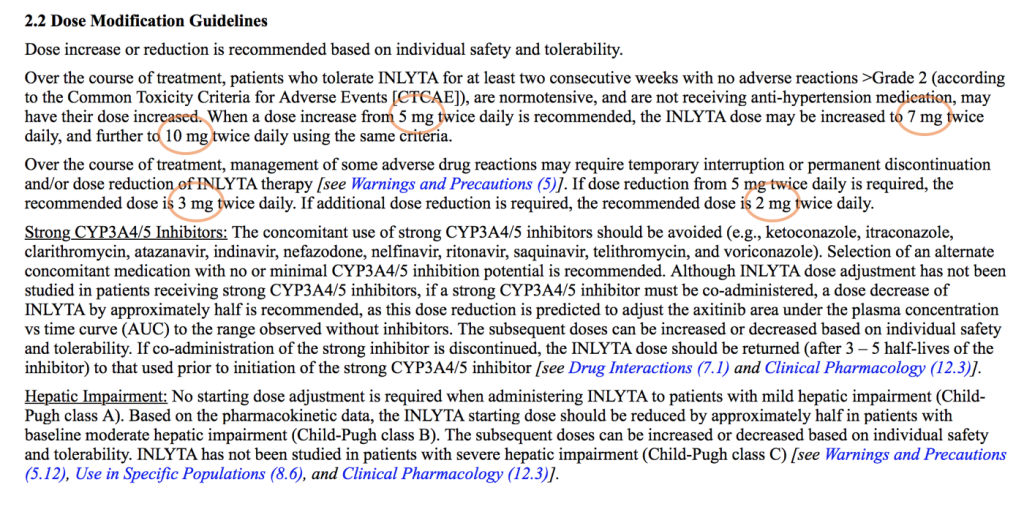
Thirdly, as I pointed out from the mic, I have a ready counterexample: axitinib (Pfizer’s Inlyta), with an FDA label that includes 5 doses—2, 3, 5, 7 and 10 mg—plus an implicit dose-titration procedure:

“That’s just one drug”

Now with this retort, Dr Ivy almost reneges on the customary rules of logic, under which a counterexample is held to effectively refute a general claim. But for what it’s worth, I’ll offer here this second counterexample, a rather complex dose titration algorithm (DTA) for venetoclax:

Source: https://www.accessdata.fda.gov/drugsatfda_docs/label/2016/208573s000lbl.pdf

(Please, don’t anyone say, “But that’s only two counterexamples…”!)

“We already do dose adjustments”

This claim, again by Dr Ivy, is true enough. But again, if you just scratch its superficial veneer, this amounts to yet another frank concession to the dose individualization agenda. The very fact that phase 1 trialists find dose adjustments necessary—i.e., modifications to the 1-size-fits-all dose-finding designs biostatisticians impose on them—itself constitutes a powerful case for designing in dose individualization as a coherent first principle from the outset.

“They’re going to die, anyway.”

Wow. Even after surveying nearly 3 decades of 1-size-fits-all dose-finding methodology predicated on this atrocious view of phase 1 cancer trial participants, I was still shocked to hear Prof Mander say it out loud.

The methodological content of 1-size-fits-all dose-finding designs, after all, objectively embodies precisely this view, through its utilitarian regard for participants. Still, it’s one thing to disguise such a view in mathematical formalism, and another entirely to state it in plain English. This degree of tone-deafness seems significant to me, for at least two reasons.

Firstly, although patient advocates did not attend this conference, they did have a substantial ‘presence’, through a series of sensitively produced video essays that opened each session. A recurring theme in these videos was the deep importance of hope as a value experienced by patients and their families through participation in phase 1 trials. In more than one of these videos, we heard from patients who had lived for many years on a trial: their hope, realized. Did Prof Mander see any of these videos? Did they leave any impression? On the contrary, what his remark reveals is the prevailing tendency within Biostatistics, to regard trial participants as remote abstractions. This is a point I addressed in my DTAT paper through Alfred North Whitehead’s notion of the fallacy of misplaced concreteness:

Secondly, we see in this remark just how endangered #OneSizeFitsAllipsism is, and how close to the edge of oblivion it is teetering. If even a single patient advocate had been in attendance at this debate, Prof Mander would have met with an immediately fatal rebuke. It is to the shame of every delegate at that conference—mine as well—that Prof Mander did not receive this immediate rebuke from one of us. That is the missed opportunity from Phase 1 Manchester that I most deeply regret.

‘Interventional pharmacoeconomics’ debases drugs and pharmacology alike

A Letter to the Editor of JAMA Oncology, desk-rejected July 15, 2019:

To the Editor: The Viewpoint by Drs. Ratain, Goldstein and Lichter1 advances a program of ‘interventional pharmacoeconomics’ (IVPE) founded on one of several cognitive distortions described by Greenland: “nullism, the tendency to privilege the hypothesis of no difference or no effect when there is no scientific basis for doing so.”2 IVPE aims to reduce drug exposure while yet “maintaining [equivalent] efficacy.”1 This incantation repeats—with ‘equivalent’ deftly elided after its initial appearance—fully 8 times throughout the Viewpoint. But its repetition ought not dull our senses to the fact that it espouses an outright exposure-response denialism. Remarkably, the authors make no secret of their intention to deploy the absence-of-evidence fallacy in prosecuting this case: When they speak of “several of the new checkpoint inhibitors for which there is little or no evidence of a relationship between dose and efficacy,” they recall unmistakably Braithwaite’s there-is-no-evidence-to-suggest.3

One might like to imagine such denialism banished to the province of homeopathy, but sadly this type of thinking has long hobbled even mainstream clinical drug evaluation.4 Still, it will only frustrate needed progress if we endorse such pharmacologic nihilism anew, in the guise of this fresh-faced field equipped with its shiny acronym plus the ample underwriting likely to accrue to a “discipline” preening itself as a servitor to corporate and government payors. Substantive scientific probing of exposure-response relationships will require the intellectual invigoration of clinical pharmacology, not its debasement to the level of financial spreadsheet analysis.

The only remedy for this looming folly would seem to be calling IVPE what it is. I suggest the term ‘drug sweating’, by analogy with the method of debasing coins by shaking them in a bag so as to recover precious-metal dust, while maintaining the ability to pass them on at full value. If this program of drug sweating prevails, then our drugs and clinical pharmacology as well will emerge worse for wear.

My main hope for IVPE would be that it does not achieve its overtly stated aims, but instead forces industry to abandon per-milligram drug pricing altogether, in favor of per-patient licensing. Such licensing seems indispensable for equitably achieving dose individualization, which in turn appears fundamental to the enlightened pursuit of optimal social value from pharmaceutical innovation.5

References

1.  Ratain MJ, Goldstein DA, Lichter AS. Interventional Pharmacoeconomics—A New Discipline for a Cost-Constrained Environment. JAMA Oncol. June 2019. doi:10.1001/jamaoncol.2019.1341

2.  Greenland S. Invited Commentary: The Need for Cognitive Science in Methodology. Am J Epidemiol. 2017:1-7. doi:10.1093/aje/kwx259

3.  Braithwaite R. EBM’s six dangerous words. JAMA. 2013;310(20):2149-2150. doi:10.1001/jama.2013.281996

4.  Sheiner LB. The intellectual health of clinical drug evaluation. Clinical Pharmacology and Therapeutics. 1991;50(1):4-9. doi:10.1038/clpt.1991.97

5.  Norris DC. One-size-fits-all dosing in oncology wastes money, innovation and lives. Drug Discov Today. 2018;23(1):4-6. doi:10.1016/j.drudis.2017.11.008

Into the Mind of the
#OneSizeFitsAllogist

I have on my bookshelf a 300-page book devoted entirely to 1-size-fits-all dose finding—a practice that any sensible layperson sees immediately as utterly wrongheaded. When a whole academic field grows up around so obviously bad an idea, this presents us with a problematic phenomenon demanding intellectually serious investigation.

Elsewhere I’ve called this phenomenon #OneSizeFitsAllipsism (rhymes with solipsism), which hints at the fuller picture I would convey in an hourlong lecture. But in this 8-minute video, I present one, immediately useful facet of my larger explanation. In doing this, I set the stage for a follow-up video, where I’ll introduce a contrasting mentality, and show how it opens the door to dose individualization.